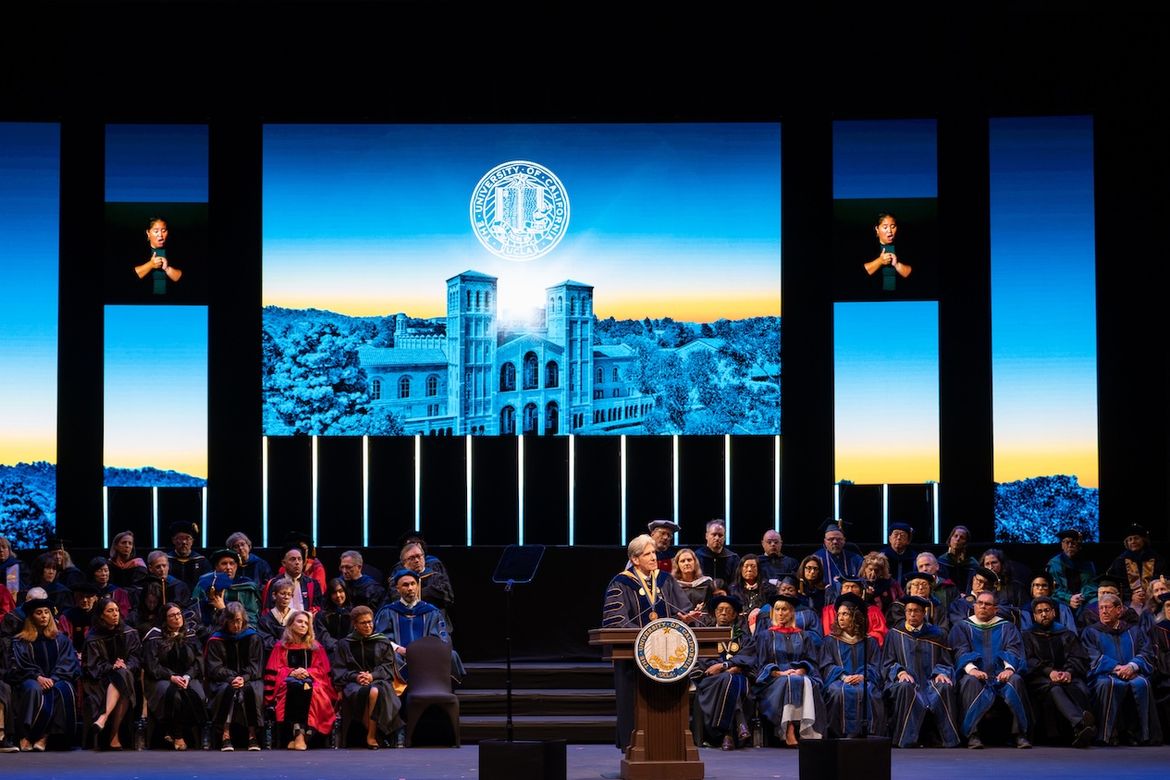
Dr. Julio Frenk, who took office in January, was officially inaugurated today as UCLA’s seventh chancellor in a ceremony in which he celebrated the university’s remarkable legacy of achievement, trumpeted its standing as the nation’s top public institution and touted the bold possibilities of its future — a future, he said, shaped by the shared hopes and aspirations of the entire UCLA community.
“I stand today before you with a deep sense of gratitude and responsibility for the opportunity to lead an extraordinary university at an extraordinary time,” Frenk, in a dark blue academic robe, told those gathered at the 10 a.m. ceremony in UCLA’s Royce Hall, including his partner Felicia Marie Knaul and other family, friends, members of the UCLA community, and local and global leaders in higher education, government and civic life.
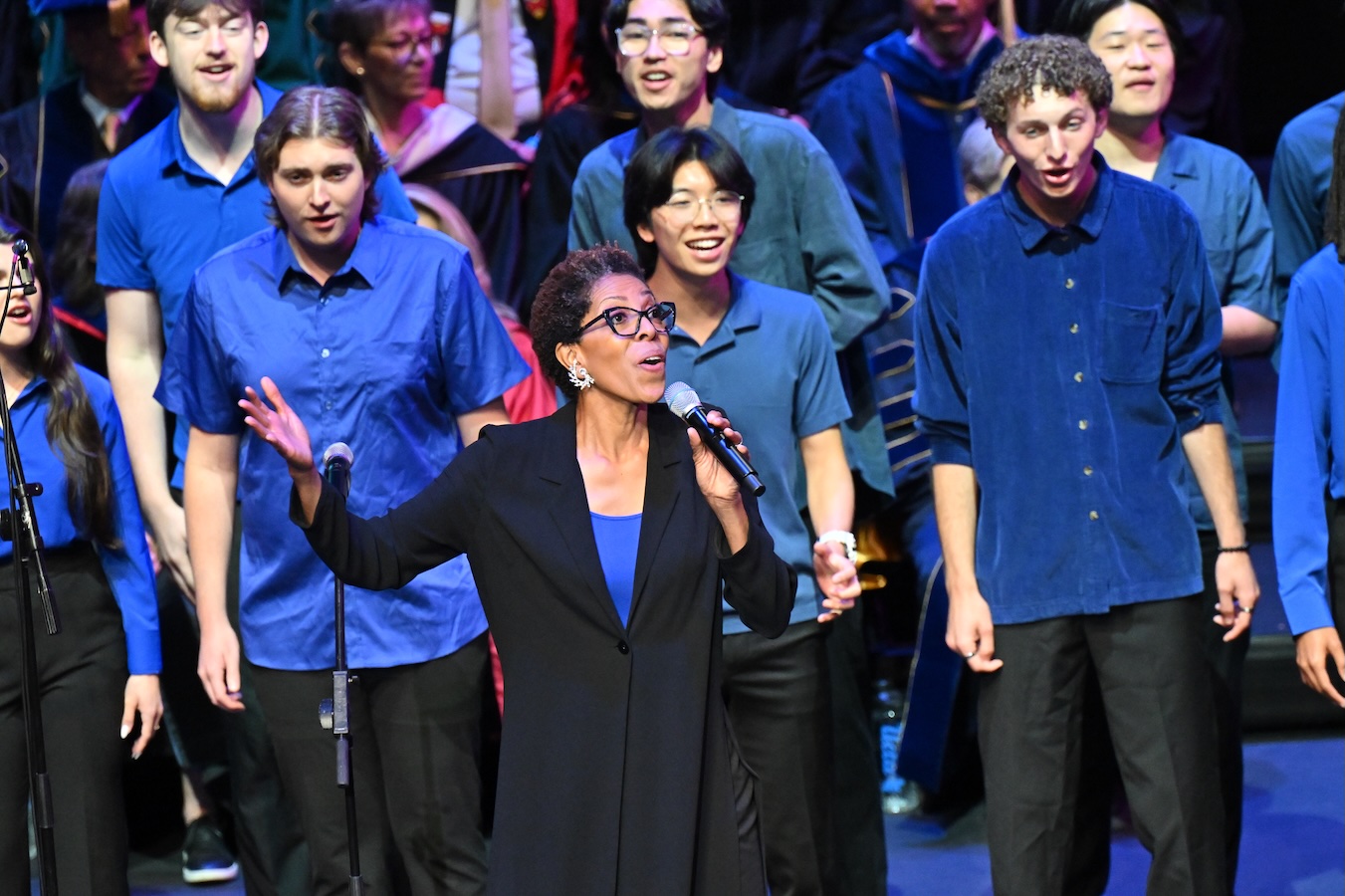
Thousands of others across campus and around the world also joined the festive, historic moment — just the third investiture of a new chancellor at UCLA in more than half a century — through the livestream internet broadcast. In addition to Frenk’s inaugural address, the morning featured a full-regalia academic procession, speeches, readings, a short film and a wide range of musical performances, including a selection from Rossini’s “The Barber of Seville” that brought a smile to the face of the chancellor, a longtime opera buff.
 Chancellor Frenk: UCLA’s three defining aspirations
During his address, Frenk drew heavily on what he’d heard from his UCLA Connects: Listening Exercise, a series of 38 intensive, immersive group conversations with nearly 6,000 faculty, students, staff and alumni from every school, unit and administrative area across campus. The goal, he said, was to hear everyone’s concerns and hopes “with open ears and an open heart and an eye toward the future that we would build together.” That experience inspired three collective aspirations that Frenk shared.
“In our collective vision,” Frenk said, “we aspire to be a university that is connective, impactful and exemplary.” He added, “UCLA will help define what a great university ought to be in the 21st century and inspire renewed trust in the promise of higher education.”
More Julio Frenk inauguration coverage
► Watch and read Chancellor Frenk’s full inaugural address
► Music to his ears: The sounds of Julio Frenk’s inauguration
► UCLA community reactions to the chancellor’s inauguration
► Watch the UCLA Connects: Bruin Talks symposium
► News coverage of the inauguration
That trust, Frenk acknowledged, has slipped in recent years.
And he emphasized that no challenge is insurmountable, so long as Bruins stay connected and continue “to advance the values that underpin our value to society.” One of UCLA’s greatest assets in this regard, the chancellor said, is the extraordinary passion and commitment of its faculty, students and staff.
“We must meet the moment with courage, resilience and wisdom,” he said. “I am determined to channel the powerful mix of talent and commitment that defines the Bruin spirit.”
Words of praise for Chancellor FrenkLos Angeles Mayor Karen Bass, UC President Michael Drake, UC Board of Regents chair Janet Reilly, UCLA Foundation chair Cheryl Lott and Chief Anthony Redblood Morales, chair of the Gabrielino–Tongva Tribal Council, were among those making remarks at the ceremony, along with representatives of UCLA’s student body, faculty and staff.
Reilly, a UCLA alumna, praised Frenk’s longtime public service and stewardship as president of the University of Miami, dean of Harvard’s T.H. Chan School of Public Health and national health secretary of Mexico. But now, she said, Frenk was “home.”
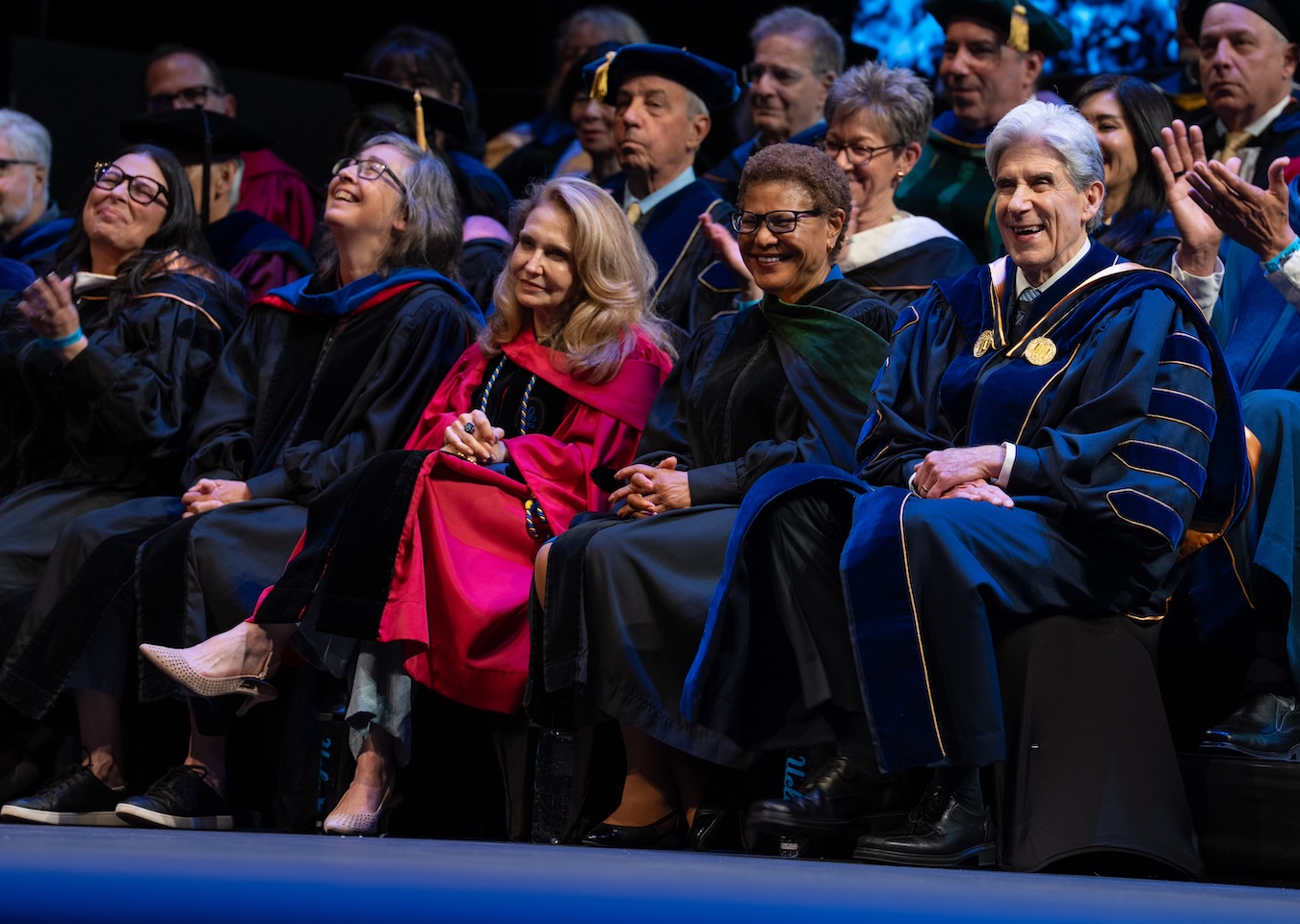
“You are now and forevermore part of this Bruin family,” she said. “And I feel so fortunate to play a small part in this moment. It is a moment that reflects the very best of what public education can offer and what it can inspire.”
Bass also spoke about how much Frenk and his leadership mean to Los Angeles and the partnership between the city and the university.
“Today is more than a ceremonial moment. It is a milestone for UCLA and for our city, and for what leadership in higher education should look like,” she said. “As mayor of Los Angeles, I see every day how deeply UCLA is woven into the fabric of our city, from the hospitals that heal, to the classrooms that inspire, to the research that transforms lives.”
Frenk, who began his first full week as UCLA’s chancellor on Jan. 6 and just a day later confronted the worst natural disaster in the history of Los Angeles, earned plaudits from speaker Kathleen Bawn, chair of UCLA’s Academic Senate, for his compassion, thoughtfulness and clarity of purpose during that crisis.
“I am particularly grateful, Chancellor Frenk, for the wisdom you showed in reminding us of the transformative power of kindness,” she said. “Individual acts of kindness create a connected community where all can thrive and learn and discover.”
Adam Tfayli, UCLA’s undergraduate student body president, who initially met Frenk last fall during one of the chancellor-designate’s early visits to campus, spoke about his confidence in the university’s future with Frenk at the helm.
“Today is not just a leadership transition. It’s a reminder that we’re not just surviving — we’re building again. And Chancellor Frenk embraces that,” Tfayli said. “UCLA, like any great ship, was never meant to stay docked. Let’s not prepare to set sail — let’s fly. We're officially installing our ship’s new captain. Get ready, hold tight. Aye-Aye.”
A connective universityFrenk himself, galvanized by the kindness he saw from the entire UCLA community during the fires, launched UCLA Connects, a universitywide framework for working, collaborating and communicating that is designed to encourage deeper, more meaningful connections among members of the campus community while also building stronger bridges between the university’s research and creative activities, its public service, and the wider world.
At a time of division and disconnection, Frenk emphasized the crucial role of UCLA and other universities in bridging divides — across generations, disciplines, geographies, eras, identities and communities.
The chancellor, who has often said that “UCLA is not just a university in Los Angeles but a university of Los Angeles,” said he would commit himself “to enhancing UCLA’s role as an active catalyst of connections within and between our internal and external communities.”
An impactful universityAs the birthplace of the internet and a global engine of creativity and innovation in science, the arts, health care and technology, UCLA should continue pushing forward in creating solutions to society’s pressing problems, Frenk emphasized.
“Great universities like UCLA understand that our positive impact does not stop when we expand the frontiers of knowledge but continues when we purposefully translate discoveries into innovations,” he said.
Major investments in initiatives like the UCLA Research Park — where both the California Institute for Immunology and Immunotherapy and the UCLA Quantum Innovation Hub are anchor projects — will demonstrate unequivocally the benefits the university brings to society and the world through its education, research and service.
And fundamental research at UCLA Health and other campus units should continue to fuel the development of novel services that improve and save lives.
“Now more than ever,” Frenk said, “we must build a sturdy bridge that connects scholarship to solutions, enabling us to fulfill our ultimate duty to society.”
Part of that effort, he said, will involve adopting new approaches that allow the university to do things better, smarter and more productively.
To that end, Frenk announced the launch of UCLA for Life, a bold initiative to position the university at the forefront of lifelong learning. Responding to the need for an educational model that evolves with students’ lives and careers, the program, Frenk said, would integrate multiple campus resources in growing its support for students beyond graduation. And UCLA will invest even more in open, lifelong learning systems with ongoing access to courses and educational resources.
Learn more about Julio Frenk and Felicia Marie Knaul
► Julio Frenk: A new chancellor, a new era
► Julio Frenk and Felicia Marie Knaul: Where the journey takes you
► Julio Frenk and UCLA: Building a better, more equitable future through public health
► Felicia Marie Knaul: Living her values
► Julio Frenk gets a warm Los Angeles welcome
► Julio Frenk to take the helm of UCLA
An exemplary universityIn many ways, the glue that must bind UCLA’s efforts going forward is a strong and connected campus, the chancellor has said. At this time of division in our nation and the world, UCLA has the potential — and the obligation — to model for the larger society how a diverse community can unite around common ideals while demonstrating respect for one another when we disagree.
Topmost in this regard has been restoring bonds and rebuilding trust among students, faculty and staff following the divisive events of spring 2024. Since taking office, in addition to the listening exercise, Frenk has made it a mission to promote and take part in town halls, workshops, community-building exercises and antidiscrimination trainings through campus initiatives that foster empathy, respect and active listening among Bruins who find themselves on opposite sides of difficult issues.
“I pledge,” Frenk said, “to listen to you as we work together to restore and reaffirm the bonds that define a true community.”
And in keeping with his concept of universities as bastions of pluralism and respectful engagement, Frenk — the son of a refugee and UCLA’s first Latino chancellor — emphasized his passionate belief that the university must foster an environment in which all people feel not only heard but safe in their right to express themselves without fear of discrimination, harassment or violence based on their perceived identity or their ideas.
“Remember that when one group becomes the target of bigotry, no one is safe,” Frenk said. “This is why we have launched a comprehensive Initiative to Combat Antisemitism, which is an essential element of our determination to end all forms of prejudice and intolerance on our campus.”
The chancellor also used his speech to announce a new series called Campus Community Conversations, part of an effort to help UCLA model how academic institutions can protect dignity, celebrate individuality and remain steadfast in their mission.
“As your new chancellor, I commit to engage passionately with everyone so that together we can restore connective relationships to all in our community,” Frenk said.
“I commit to serve this university as everyone’s chancellor.”
Moving forward with boldness“As UCLA has evolved from a humble beginning to vigorous building and to remarkable breaking through,” Frenk said, “its trajectory has been fueled by boldness. We are now entering a new era where such boldness will be more necessary than ever before. This is not a time to retreat. It is a time to be bold.”
UCLA, the chancellor said, must be bold in standing up for the enlightened values of higher education, defending the search for knowledge as a cornerstone of democracy, translating discoveries into solutions, promoting access and opportunity, innovating in education, healing divides and pursuing excellence in all it does.
The boldness that transformed the fledgling Southern Branch of the University of California, a tiny college with just 1,300 students, into the nation’s top-ranked public university and one of the most revered research universities in the world in just a century is the boldness that still defines us, Frenk said. “And we are just getting started.”
“I stand here with full confidence,” he said. “UCLA is more than ready to meet the moment.”